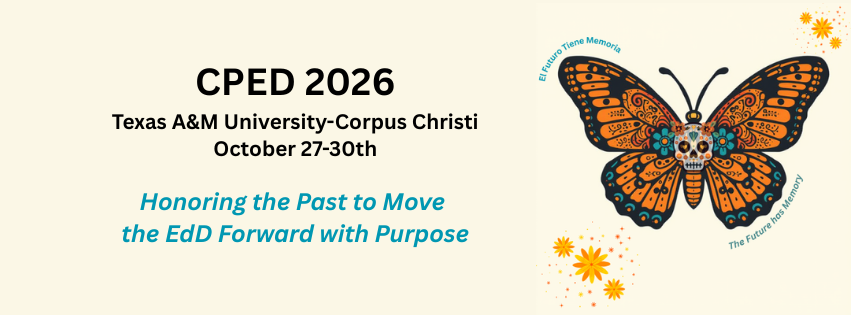
El Futuro Tiene Memoria (The Future Has Memory): Honoring the Past to Move the EdD Forward with Purpose
Hosted by Texas A&M University–Corpus Christi
October 27-30, 2026
“Education is our freedom, and freedom should be everybody’s business.” — Dr. Hector P. García, MD
The 2026 CPED Convening, El Futuro Tiene Memoria, invites educational leaders and scholar-practitioners to reflect on how memory—personal, institutional, and communal—shapes the future of the Doctor of Education (EdD). Hosted in Corpus Christi, Texas, a city rooted in civic engagement and landmark struggles for educational equity, the convening centers place, history, and responsibility as foundations for purposeful leadership.
As EdD programs face increasing pressure to demonstrate relevance, coherence, and community impact, this convening calls us to return to the stories, struggles, and values that have shaped our work. Memory is not a constraint; it is a guide. By engaging institutional histories, lived experiences, and program legacies, we can reimagine leadership preparation that is ethical, contextually responsive, and justice-oriented.
As we gather near Día de los Muertos 2026—a time of remembrance and honoring those who came before us—participants are invited to reflect on the legacies their EdD programs carry forward and the futures they seek to design. Together, we will explore how institutional memory can inform innovation, strengthen practice-based scholarship, and advance the EdD with intention and care.
El futuro tiene memoria. The future has memory.
Read the full convening theme HERE.
Watch the Call to Convening video HERE.
Call for Pre-Convening Workshops & Learning Exchange Proposals
We invite you, your colleagues, and your students to submit proposals for pre-convening workshops and convening learning exchanges that explore and share how your EdD programs engage with history, context, and legacy.
This year’s convening invites proposals that thoughtfully address one or more of the following themes:
1. Interrogate Our Past
-
What personal and institutional histories—told and untold—have shaped your EdD program and warrant further exploration?
-
How do the lived experiences of faculty and students influence the program’s identity, structure, and direction?
2. Engage in Institutional Context
-
How and where do your EdD students reflect on the cultural, regional, and institutional histories of your context?
-
How do these histories shape curriculum, inquiry, or leadership preparation?
3. Design Intentional Legacies
-
What legacy—values and commitments—does your program aspire to leave behind?
-
If your program were an ofrenda (altar), what voices, visions, and hopes would you honor?
Learning Together at the CPED Convening
The central feature of a CPED convening is coming together to share, learn, and improve EdD programs collectively. Learning exchanges and pre-convening workshops are intentionally idea-centered and designed to engage multiple voices, pedagogies, and perspectives. Sessions should create space for critical-friends conversations, active participation, and high expectations for learning together.
As you consider submitting a proposal, we encourage you to design sessions that are interactive, dialogic, and generative, and—when possible—develop exchanges across institutions.
If you would like your exchange associated with a CPED Improvement Group (CIG), review the 2026 CPED Improvement Group Calls for Learning Exchanges HERE.
To support proposal development, we offer the session descriptions and examples below.
Session Types
Learning Exchanges
60 minutes | Interactive, collaborative sessions
Learning Exchanges are interactive sessions connected to the convening theme and offered by one or more CPED member institutions. These sessions emphasize collaborative learning, shared inquiry, and practical takeaways that participants can use to strengthen their EdD programs.
Learning Exchanges are designed to:
-
Facilitate learning through dialogue, collaboration, and reflection
-
Share practices, questions, or lessons learned from EdD programs
-
Engage participants as co-learners and critical friends
-
Generate ideas, tools, or resources for program improvement
Example formats include (but are not limited to):
-
Program or initiative case studies
-
Flipped or interactive learning sessions
-
Workshopping ideas or designs
-
Ignite-style sessions
-
Roundtables or facilitated dialogues
-
Fishbowl discussions
-
Jigsaw or world café formats
-
Book or article discussions
-
Arts-based or creative learning activities
Pre-Convening Workshops
2 hours | Extended learning and skill development | held on the day or morning before convening begins
A limited number of pre-conference workshops will be offered prior to the convening. These workshops include the benefits of Learning Exchanges while allowing for deeper exploration of topics and more sustained engagement. Workshops are well-suited for sessions that require extended time for learning, practice, and collaborative creation.
Pre-convening workshops are ideal for sessions that:
-
Offer deeper learning of a skill or approach related to EdD programs
-
Engage participants in hands-on or applied learning
-
Support collaborative design or knowledge creation
-
Explore methodologies, tools, or CPED principles in depth
Example workshop activities include:
-
Training on methodologies, teaching techniques, or tools
-
Research, writing, or idea incubators
-
Collaborative syllabus or curriculum development
-
Co-creation of program materials or shared resources
-
Structured exploration of CPED principles or design concepts
Additional Information
-
All learning exchange and workshop proposals will be double-blind and peer-reviewed by CPED member faculty and CPED staff.
-
Proposals that offer engaging, interactive learning experiences for CPED’s diverse community will be prioritized.
-
Members interested in associating their session with a CPED Improvement Group (CIG) should review the 2026 CPED Improvement Group Calls for Learning Exchanges.
SUBMITTING A CONVENING WORKSHOP OR LEARNING EXCHANGE PROPOSAL
All Learning Exchange and Workshop proposals should be no more than 1000 words and include the following:
-
Type of session (Learning Exchange with descriptor, e.g., round table, world café, etc.)
As a membership organization, we look to our member faculty to ensure continued quality programming. A great way to support your understanding of CPED and EdD (re)design is to review convening learning exchanges proposals. Therefore, the CPED member who completes the exchange submission form will be expected to review four to five exchange proposals to assist in the convening exchange process.
Pre-convening Workshop Proposals must be submitted HERE by February 25, 2026.
Exchange Proposals should be submitted HERE by May 18, 2026.
TIMELINE FOR REVIEW AND ACCEPTANCE
February 25, 2026: Pre-convening Workshop proposals due
March 2026: Double-blinded Peer Review of Pre-convening Workshop proposals
April 2026: Notification of Pre-convening Workshop Acceptance
May 18, 2026: Learning Exchange Proposals due
June 2026: Double-blinded Peer Review of all Learning Exchange proposals
July 2026: Notification of Learning Exchange acceptance
If accepted, please note:
-
All pre-convening workshops and learning exchange presenters are expected to register for the convening.
-
CPED cannot guarantee a particular day or time slot for Learning Exchanges. All pre-convening workshops take place on the day or morning before the opening of the convening.
-
By submitting a Learning Exchange proposal, you agree to be available for all days of the 2026 CPED Convening.
Questions about Learning Exchanges or Pre-convening Workshops: Contact Monica Wilkerson, Coordinator of Operations and Development at [email protected] or 412-648-7428.
CALL FOR SCHOLARLY PRACTITIONER POSTERS
We invite scholarly practitioners (students/graduates of EdD programs) from CPED member institutions to share their current research which supports the CPED values of multiplicity, learning, partnership, people, social justice, and students first through a poster exhibit. Each scholarly practitioner will be expected to present their posters at the 2026 CPED Convening held in Corpus Christi and hosted by Texas A&M University – Corpus Christi from October 27-30, 2026.
Each poster proposal should include the following:
In no more than 1-page (approx. 500 words), each proposal should include the following information:
1. The stage of your scholarly practitioner research
2. A description of how your research:
-
blends practical wisdom with professional skills and knowledge to name, frame, and solve a problem of practice,
Scholarly Practitioner Poster Proposals should be submitted HERE by May 18, 2026.
If accepted, please note:
- All Scholarly Practitioner poster presenters are expected to register for the convening.
- CPED is not able to guarantee a particular day or time slot for posters.
- By submitting a Scholarly Practitioner proposal, you agree to be available for all days of the convening.
Questions about Scholarly Practitioner Posters: Contact Monica Wilkerson, Coordinator of Operations and Development at [email protected] or 412-648-7428.
Coming Soon!
Mid-March - Convening Registration & Hotel Information
Questions? Please contact Monica Wilkerson, Coordinator of Operations and Development at [email protected] or 412-648-7428.
|